
Hair Restoration in Toronto
What Are Your Options?
What Is Hair Restoration?
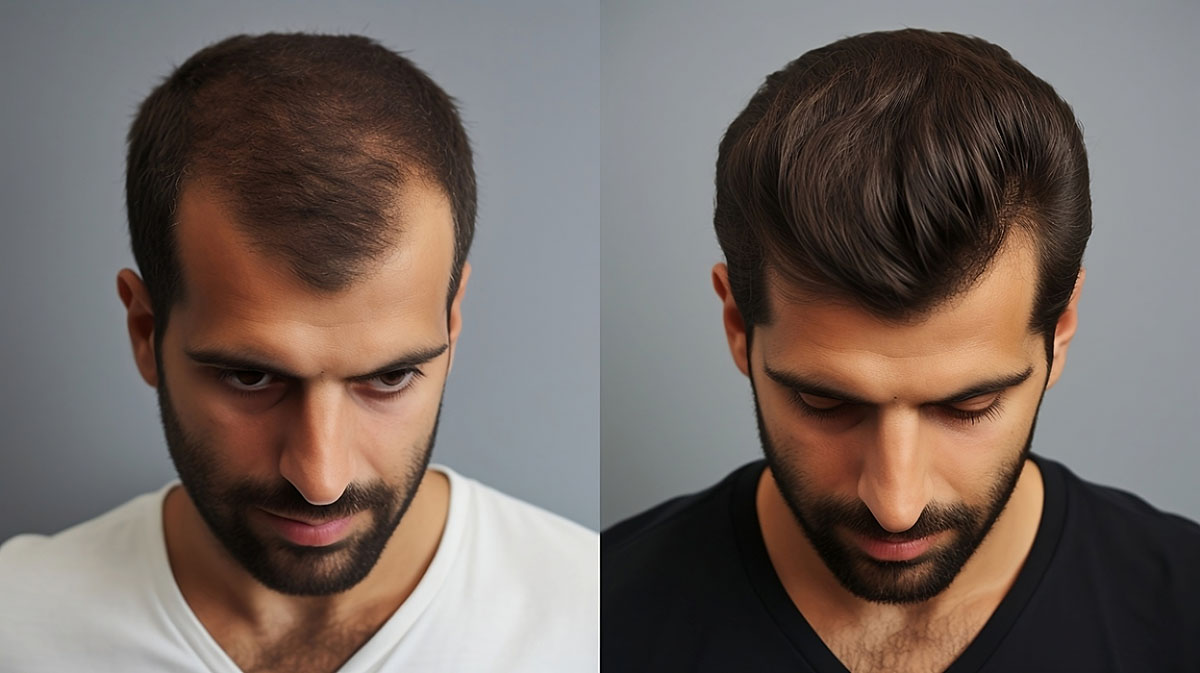
Hair restoration is the umbrella term for any treatment aimed at regrowing, thickening, or replacing hair lost to pattern baldness. That spans surgical hair transplant techniques like follicular unit excision (FUE) and follicular unit transplantation (FUT), along with non-surgical options such as platelet-rich plasma (PRP) therapy injections, laser therapy, and medication that blocks dihydrotestosterone (DHT). Some men only ever need one of these. Others combine a transplant with ongoing PRP or medication to protect the hair around it.
Non-Surgical Hair Restoration Options
Non-surgical hair restoration options tend to work best in the earlier stages of hair loss, before an area has gone fully bald. They are often paired with a transplant afterward to protect the native hair that wasn’t moved.
- PRP hair restoration: A small amount of your own blood gets drawn, the platelets concentrated, and the solution injected into the scalp, where those growth factors support existing follicles and can slow further thinning. Early sessions run a few weeks apart, tapering off to maintenance visits every few months once things stabilize.
- Low-level laser therapy: This procedure uses red light to stimulate the scalp over repeated sessions, either in-clinic or with a take-home device like Theradome. It’s slower going than PRP, but there’s no needle involved, and it plays well alongside pretty much any other treatment.
- DHT-blocking medication: Finasteride by prescription, or topical options like minoxidil, work by cutting DHT production or stretching out the hair growth cycle. This option is commonly layered in alongside PRP or laser therapy rather than used on its own.
How Surgical Hair Restoration Works
When non-surgical options aren’t enough on their own, surgery is the other route. Hair transplant surgery moves healthy follicles from a donor area, usually the back or sides of the scalp, into the spots where hair has thinned or gone entirely. There are two main techniques: FUE, which extracts individual follicles one at a time, and FUT, which removes a strip of donor tissue and separates it into grafts. Both aim for the same outcome, just with different trade-offs in cost, scarring, and recovery.
How Much Does Hair Restoration Cost in Toronto?
For surgical hairline restoration, the price tag is really a function of two things: how many grafts you need and how much each one costs. Toronto clinics generally charge $4 to $8 per graft, with the exact number depending on the surgeon and the technique used. A smaller session focused on the hairline might use 1,000 to 1,500 grafts, while a more extensive case covering the crown and frontal area can run 2,500 to 3,500 grafts or more.
PRP and other non-surgical treatments are priced by the session and cost a lot less up front, though you’re paying for them on an ongoing basis rather than once. Most clinics give an exact quote only after a consultation, since graft count and treatment plan depend entirely on your specific pattern of hair loss.
The technique also affects price. FUE is more labour-intensive, since each follicle is extracted individually, and it generally runs higher per graft. FUT tends to cost less and is often the more economical route if you need a lot of grafts. However, it does leave a thin linear scar that FUE avoids entirely.
Will OHIP Cover Hair Restoration?
No. Hair restoration, whether surgical or non-surgical, is considered a cosmetic and elective procedure in Ontario, so OHIP doesn’t cover it. Most private insurance plans exclude it too, though many clinics offer financing options that let you spread the cost over several months.
What’s the Best Age for Hair Restoration?
There’s no universal answer, but most surgeons prefer to wait until a patient’s hair loss pattern has stabilized, usually somewhere in the mid-to-late 20s or early 30s. Operating too early on a hairline that’s still receding can mean that the transplanted hair looks out of place a few years later, once the surrounding native hair has thinned further. PRP and DHT blockers aren’t bound by the same timing, since they are aimed at slowing loss rather than building a permanent new hairline, so they can reasonably start much earlier.
How Painful Is a Hair Graft?
“Uncomfortable” is closer to the truth than “painful” for most patients going through hair transplant surgery. The scalp is numbed with local anesthetic before extraction and implantation begin, so the worst part for most people is the initial injections. After that, patients are often able to watch a movie, listen to music, or nap through the rest of the session. Expect some tightness, mild soreness, and scabbing around the grafts for the first week to 10 days.
What Happens 10 Years After a Hair Transplant?
Transplanted follicles are typically taken from the back and sides of the scalp, an area that’s naturally resistant to DHT, the hormone responsible for pattern baldness. These hair follicles remain DHT-resistant no matter where they are implanted, which is why transplanted hair is generally considered permanent and keeps growing normally for life, well past the 10-year mark and beyond.
The hair around the transplant is a different story. It runs on its own clock and can keep thinning as time passes, which can shift how the hairline looks overall, even though not one transplanted graft has actually gone anywhere. That’s usually why patients add PRP, laser therapy, or medication into the mix after surgery, to protect the hair that wasn’t part of the transplant and to keep everything looking consistent well into the future.
Do People Regret Hair Transplants?
Two things usually drive regret: expectations that were unrealistic from the start, or a hairline that reads as obviously artificial because it wasn’t designed with the patient’s age and facial structure in mind. Go in with a realistic picture of what surgery can actually deliver and pick a surgeon who is willing to put real thought into hairline design, and the odds of disappointment drop considerably. It’s also why so much of the process comes down to that initial consultation and hairline design, not just the surgery itself.

Finding the Right Hair Restoration Clinic in Toronto
Sovereign Male offers PRP and laser therapy for hair restoration in-house. For patients who are candidates for surgery, we work directly with Toronto Hair Transplant Clinic, so there’s a clear path forward whether your best option is non-surgical, surgical, or a combination of both.
If you’re ready to talk through where you stand, review our hair loss page and book a consultation. A hair restoration plan built around your specific pattern of loss, rather than a generic recommendation, is always going to get you further.


